
Perhaps an Instagram page that hasn't been updated in six months.
Perhaps a Facebook account with limited information.
Perhaps a WhatsApp number.
Perhaps nothing.
Now imagine a different experience.
They search for your business and find a professional website containing your company description, services, location, contact information, photographs, frequently asked questions, products, booking options and other useful information.
The difference is not simply aesthetic.
It is informational.
One presence leaves the customer to piece the story together.
The other tells the story clearly.
This is particularly important for businesses that depend on trust.
Think about a doctor.
A school.
A lawyer.
An accountant.
A travel company.
A construction company.
An event planner.
A consultant.
A financial service.
A caterer.
A technology company.
A customer may not immediately buy from any of these businesses simply because they have found them online.
They may first investigateFor years, the internet taught businesses a fairly simple lesson: if you wanted to be found, you needed to show up where people were searching.
That usually meant search engines.
A customer had a question, opened a browser, typed a few words into a search box and looked through the results.
Businesses learned to optimise their websites, choose relevant keywords, publish useful content and compete for attention on search results pages.
Then social media changed the game.
People began discovering businesses while scrolling rather than deliberately searching for them. A restaurant could become popular because of a video. A fashion designer could gain customers because of an Instagram post. A small business could reach thousands of people without spending heavily on traditional advertising.
For a while, it seemed possible that social media might eventually replace the traditional business website.
But technology rarely moves in a straight line.
Instead, another transformation is taking place.
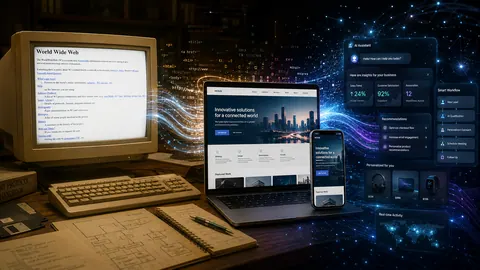
Artificial intelligence is changing the way people find, consume and interact with information.
And businesses are going to have to think differently about what it means to be discoverable.
Consider how people are beginning to use AI assistants.
Instead of searching for dozens of websites themselves, someone can ask a question in plain language:
“Who are the best event decorators in my area?”
“What website design company can help a small business launch quickly?”
“Where can I find a reliable caterer for a wedding?”
“What are the best options for accounting services for a growing business?”
The person isn't necessarily asking for a list of keywords.
They are asking for an answer.
That difference may seem small, but it represents a significant change in the relationship between customers and the internet.
Traditional search largely asked people to find information.
AI increasingly attempts to help people make sense of information.
And somewhere behind those answers are businesses, organisations, products, services and websites containing the information that makes those answers possible.
This is why the website is entering another important phase of its evolution.
A website is no longer simply something a human visitor looks at.
It is also part of the information ecosystem that digital systems need to understand.
That doesn't mean that having a website guarantees that an AI system will recommend your business. It doesn't. There are many factors involved in how information is discovered, evaluated and presented.
But it does mean that businesses should think seriously about what information about them exists online, where it exists and how clearly that information communicates who they are and what they do.
A social media post can say, “We provide professional event decoration.”
A website can explain what that actually means.
It can tell a potential customer where the company operates, what services it offers, who it serves, what makes its approach different, how to make an enquiry and how to contact the business.
It can provide context.
And context is becoming increasingly valuable in a world where machines are learning to understand information rather than simply match words.
This is one reason I find the current evolution of the internet so fascinating.
We have moved from websites being designed primarily for humans to read, to websites being increasingly connected to systems that help humans find, interpret and act on information.
The business website is becoming part of a much larger digital conversation.
But there is another important reason businesses should pay attention.
Your customers do not necessarily have the patience to investigate you from scratch.
Imagine that someone hears your company name from a friend.
They become curious.
They search for you.
What do they find?
.
They want reassurance.
They want evidence that the business exists.
They want to understand what it does.
They want to know how to reach someone.
They want to determine whether the business looks professional enough to deserve their money.
The website can become an important part of that verification process.
This is why I don't think businesses should look at websites simply as marketing tools.
A website can also be an information asset.
It gives your business a place where the important facts about what you do can live together.
And that becomes even more important when customers are discovering businesses through multiple channels.
Someone might see your TikTok video.
Another person might discover your company through Instagram.
Someone else might hear your name from a friend.
Another customer might encounter you through an advertisement.
Another might ask an AI assistant a question.
The discovery journey can begin almost anywhere.
But eventually, the customer often needs somewhere to go.
That is where the website becomes important.
Social media is excellent at creating movement.
It creates conversations.
It creates visibility.
It creates attention.
It can make people curious about a business.
But curiosity needs somewhere to land.
Social media can help people discover you. Your website gives them somewhere to know you.
That distinction becomes even more important as social platforms continue to change.
An algorithm can determine who sees your content.
A platform can change its rules.
A new feature can become popular while another disappears.
An account can perform brilliantly one month and struggle to reach its audience the next.
Businesses should absolutely use these platforms. They are powerful.
But building your entire digital identity on platforms you do not control is a different proposition.
A website gives you something that social media cannot completely replace: an owned digital destination.
It can sit quietly at the centre of your digital ecosystem while everything else points toward it.
Your Instagram profile can point to it.
Your TikTok profile can point to it.
Your YouTube channel can point to it.
Your email signature can point to it.
Your advertisements can point to it.
Your WhatsApp messages can point to it.
And your customers can bookmark it.
That is not an argument against social media.
It is an argument for understanding what each digital channel is actually good at doing.
The same principle applies to artificial intelligence.
AI may become an increasingly important discovery layer, but businesses still need authoritative places where information about their products and services can be found.
The internet is becoming more conversational, but conversations still need reliable information behind them.
This is why the next generation of business websites will need to do more than look attractive.
They will need to be useful.
They will need clear information.
They will need good structure.
They will need accurate business details.
They will need relevant content.
They will need to work well on mobile devices.
They will need to make it easy for customers to take action.
And increasingly, they will need to connect with the other digital systems businesses use to operate.
The website is becoming less like a sign hanging outside a shop and more like the shop itself.
The sign tells you that the shop exists.
The shop lets you walk in, look around, ask questions and buy something.
That is the direction websites have been moving for years.
Artificial intelligence is simply accelerating the transformation.
And this brings us back to a question that many business owners continue to ask:
“Is it really necessary for me to have a website?”
Perhaps a better question is:
“What happens when someone is looking for exactly what I offer, and there is no clear digital home for my business?”
The cost of being invisible is not always obvious.
It may be the customer who never contacts you.
The enquiry that goes to a competitor.
The person who cannot verify your business.
The opportunity that disappears because finding the information they need is too difficult.
In business, missed opportunities rarely announce themselves.
You simply never know they happened.
The encouraging part is that getting a professional website no longer has to feel like a massive undertaking.
The technology and tools available to modern website creators have changed dramatically.
At Auxi Sherpa, that change has made it possible to offer businesses a professional website within 72 hours.
That is a remarkable contrast to the way many people still imagine website development—as a process that automatically requires weeks or months before a business can establish its digital presence.
The internet has become faster.
The tools have become smarter.
The processes have become more efficient.
And businesses have more options than ever before.
The question is whether they will take advantage of them.
The future of business discovery will not belong exclusively to search engines.
It will not belong exclusively to social media.
And it will not belong exclusively to artificial intelligence.
It will be a connected ecosystem in which customers move between platforms, conversations, recommendations, searches and digital experiences.
Businesses that understand this will stop asking which platform they should depend on.
They will start building a digital presence that works across all of them.
And at the centre of that presence, there is still something remarkably powerful:
A website that clearly tells the world who you are, what you do and how people can do business with you.
If your business does not yet have that digital home, you don't necessarily have to spend another six months planning it.
You can start now.
Businesses interested in getting a professional website created and ready within 72 hours can contact Auxi Sherpa at admin@auxisherpa.com to begin the process.
Because the internet has changed.
The way people discover businesses is changing.
Artificial intelligence is changing what search can look like.
And the businesses that prepare for that future will have something valuable waiting when the next customer starts asking:
“Who can help me with this?”
The question is no longer simply whether your business is online.
The question is whether your business can be found, understood and trusted when the customer gets there.
Continue Reading: Why Every Serious Business Needs A Website