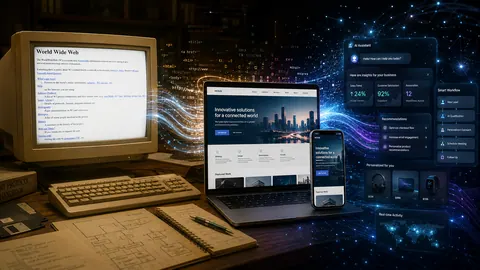

For many years, one of the biggest goals of digital marketing was simple: get your business onto the first page of Google.
Businesses spent a lot of time and money choosing the right keywords, writing blog posts, building links, improving their websites, and tracking their Google rankings. The idea was simple. When someone searched for something related to your business, you wanted your website to appear near the top.
But things are changing.
Today, people are not always searching Google and looking through a long list of websites. Increasingly, they are asking AI tools direct questions and expecting direct answers.
Instead of asking, “Which websites offer digital marketing services in Lagos?” someone might ask, “What are the best digital agencies in Lagos for a small business?”
And AI can give them an answer.
This changes the game for businesses.
The question is no longer only, “How do I get my website to page one of Google?”
The bigger question is now:
“How do I make AI understand my business well enough to recommend me?”
This is important because traditional Google search and AI search work differently.
In traditional search, someone types a question, Google shows a list of websites, and the person decides which link to click.
With AI search, the AI can read information from different sources, understand what the person is asking, and give them a direct answer. It may even recommend specific businesses.
That means the customer may not need to visit ten different websites before deciding what to do.
For example, imagine a business owner in Lagos asking an AI tool:
“What are the best digital agencies in Lagos that can help me generate leads using AI?”
Instead of simply showing a list of websites, the AI may provide a shortlist of businesses and explain why each one could be a good choice.
The customer can then ask more questions:
“Which one works with small businesses?”
“Which one offers AI lead generation?”
“Which one has experience with my industry?”
“Which one should I contact first?”
At that point, AI is no longer just helping someone search.
It is helping them make a buying decision.
And that is where things get very interesting for businesses.
Your business may have an excellent website and still be invisible when someone asks AI for a recommendation.
Why?
Because AI does not look at your website alone.
It can build an understanding of your business from many different places online. This can include your website, social media pages, business directories, reviews, articles about your company, industry publications and other public information.
This means that consistency matters.
Imagine your website says that your company specialises in AI automation.
But your social media pages mainly talk about graphic design.
Your business directory says you provide general IT services.
And an old review describes services you stopped offering three years ago.
What does AI make of all that?
It may not be completely sure what your business actually does.
And when an AI system is unsure about one business but finds another business with clear and consistent information, the second business may have an advantage.
This is one of the reasons a new area of digital marketing is becoming increasingly important: Generative Engine Optimisation, or GEO.
The name may sound complicated, but the idea is actually quite simple.
Traditional SEO focuses heavily on helping search engines understand and rank your website.
GEO focuses on making your business easy for AI systems to understand, trust and mention when answering people's questions.
It is not simply about putting the same keyword on your website hundreds of times.
It is about making sure your business has a clear digital identity.
Who are you?
What do you offer?
Who do you serve?
Where do you operate?
What makes you different?
What evidence shows that you can do what you claim?
The clearer the answers are across your online presence, the easier it becomes for both people and AI systems to understand your business.
But there is another important part of this conversation.
Getting recommended by AI is not the same as getting a customer.
Imagine an AI recommends your company to 100 potential customers.
If those people visit your website and cannot quickly understand what you offer, find your contact details, request a quote or book a consultation, you may still lose the business.
That is why AI visibility needs to be connected to a proper lead-generation system.
Your website needs to explain your services clearly.
Your content needs to answer the questions your customers are asking.
Your online profiles need to tell the same story.
And when someone becomes interested, there needs to be an easy way to turn that interest into an actual conversation.
This is where the future of digital marketing is heading.
It is no longer enough to simply “be online.”
Your business needs to be understandable, trustworthy and easy to discover across the digital world.
Think of it this way.
Your website tells people what you do.
Your content shows that you know what you are talking about.
Your reviews and online presence build trust.
AI systems connect all that information.
And your lead-generation system turns that attention into potential customers.
The businesses that understand this early will have an advantage.
Because the next big question may not be:
“Are you on the first page of Google?”
It may be:
“When your ideal customer asks AI who they should trust, does your business come up?”
At Auxi Sherpa, we help businesses build the digital systems needed for this new kind of visibility and lead generation. From professional websites and content to AI-powered lead-generation strategies, the goal is not simply to help your business appear online. It is to help the right customers find you, understand what you offer, and take the next step.
If you are ready to begin, send an email to admin@auxisherpa.com and request a professional website from Auxi Sherpa.