There was a time when having a website was considered remarkable.
Today, not having one can be remarkable for an entirely different reason.
The internet has changed dramatically since the first websites appeared. What began as a relatively simple system for sharing documents and information has evolved into one of the most important infrastructures in modern business.
And sitting at the centre of that transformation is something many people now take for granted:
The website.
For some businesses, a website is still treated as little more than an online brochure, a place where someone can find a phone number, read a few paragraphs about the company, and perhaps look at some pictures.
But that understanding belongs to an earlier era.
The modern website can sell products, collect payments, generate leads, answer questions, schedule appointments, deliver services, communicate with customers, connect to databases, integrate with other software, and increasingly use artificial intelligence to perform tasks that once required human intervention.
The website has travelled a long way.
And understanding that journey tells us something important about where business is heading next.
The early World Wide Web was remarkably different from the internet most people know today.
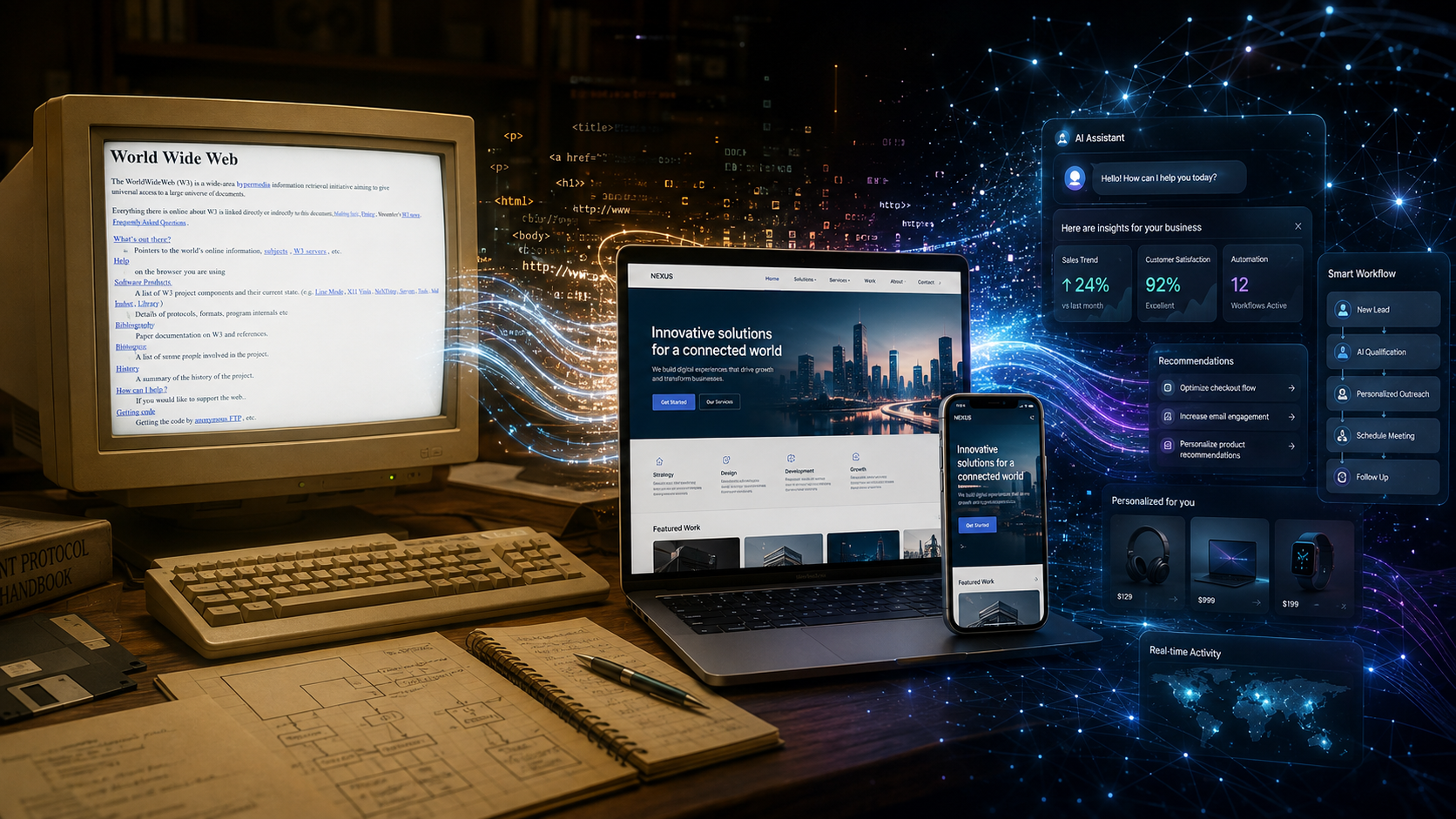
In the early 1990s, websites were primarily collections of text and hyperlinks. There were no sophisticated shopping experiences, social feeds, recommendation engines or interactive business dashboards.
A webpage could be little more than text, links and a few basic images.
But that simplicity was revolutionary.
For the first time, information could be published and accessed across a global network in a way that was relatively inexpensive and remarkably fast compared with traditional publishing.
The website became a new kind of publishing space.
Then businesses began to notice.
As internet adoption grew, companies began creating websites to establish an online presence.
At first, the business website was essentially a digital brochure.
A company could tell the world:
This is who we are.
This is what we do.
This is where you can find us.
This is how you can contact us.
That may sound basic today, but it represented a significant change in how businesses presented themselves.
A company no longer had to depend entirely on a physical office, printed brochures, newspaper advertisements or word of mouth to introduce itself to potential customers.
It could have a digital address.
And that idea would become increasingly powerful.
The next major transformation came when websites stopped simply displaying information and started facilitating transactions.
E-commerce changed the relationship between businesses and customers.
A customer could browse products from home, compare prices, add items to a virtual shopping cart and eventually make a purchase without entering a physical store.
The website was no longer merely telling people about a business.
It was becoming part of the business itself.
This distinction matters.
A digital brochure provides information.
A business infrastructure performs functions.
The more technology developed, the more websites began moving toward the second category.
Another major development was the emergence and growth of content management systems and other tools that allowed people to create and manage websites without having to build every page from scratch.
This lowered the technical barrier to entering the web.
Businesses could publish articles.
Update products.
Create landing pages.
Manage images.
Collect customer information.
Publish news.
Build communities.
The website became more dynamic.
Instead of creating a website once and leaving it untouched for years, businesses could continually update and develop their digital presence.
The website was becoming a living business asset.
There was another transformation that fundamentally changed website design which is
The mobile revolution.
The internet stopped being something people primarily accessed from desktop computers.
People began carrying the internet in their pockets.
Suddenly, a website that looked beautiful on a large computer screen but was difficult to navigate on a phone was no longer good enough.
Businesses had to think about mobile users.
Websites had to become responsive.
Pages needed to load quickly.
Buttons needed to be easy to tap.
Menus needed to work on smaller screens.
Information had to be accessible wherever the customer happened to be.
The website was no longer designed simply for the computer sitting on someone's desk.
It had to follow the customer.
And for a while, something interesting happened.
Businesses began asking a question:
“Do we still need a website when we have social media?”
Platforms such as Facebook, Instagram, YouTube, TikTok, and others gave businesses something websites had traditionally required significant effort to achieve: an audience.
A business could create an account, publish content, and potentially reach thousands, or millions, of people.
Social media became an extraordinary marketing and discovery tool.
But it also introduced a fundamental distinction that businesses sometimes overlook.
A social media account is never the same thing as owning a digital home.
Your business can build an audience on a platform, but the platform controls the environment.
Its algorithms can change.
Its policies can change.
Its features can change.
Its reach can change.
Your website is different.
It gives your business a digital property that can sit at the centre of your online presence.
Social media can send people there.
Advertising can send people there.
Search engines can send people there.
Emails can send people there.
And increasingly, AI-powered discovery can send people there.
Social media didn't make websites irrelevant.
It changed the role websites play in the broader digital ecosystem.
The evolution didn't stop there.
Modern websites increasingly behave less like traditional pages and more like software applications.
Think about what people now do through a browser.
They book flights.
Apply for jobs.
Make payments.
Attend classes.
Manage businesses.
Order food.
Book hotels.
Schedule appointments.
Collaborate with colleagues.
Track deliveries.
Manage finances.
Run marketing campaigns.
Communicate with customers.
In many cases, the user doesn't even think of these experiences as “visiting a website.”
They simply think of them as using a service.
That is how far the web has evolved.
The browser became a gateway to software.
And the website became increasingly capable of doing actual work.
We are now entering another chapter.
Artificial intelligence is changing how websites are created, how they communicate with visitors and how businesses use them.
AI can assist with content creation, customer support, data analysis, personalization, recommendations, workflow automation and software development.
A website can increasingly become more than a place where customers read information.
It can become a digital employee.
Imagine a website that answers common customer questions at any hour.
A website that collects enquiries while the business owner is sleeping.
A website that helps customers find the right product.
A website connected to booking systems, payment platforms, customer databases and communication tools.
A website that automatically moves information from one business system to another.
The technology behind websites is becoming increasingly sophisticated.
But something else is happening at the same time.
The time required to create digital experiences is shrinking.
For years, many small businesses viewed website creation as a major project.
There were meetings.
Design stages.
Content preparation.
Development.
Testing.
Corrections.
More testing.
More corrections.
And sometimes, after all of that, the website still wasn't ready.
Technology is changing that process.
Modern website platforms, reusable components, automation and AI-assisted development can dramatically accelerate many parts of website production.
That doesn't mean that every website can—or should—be produced with the push of a button.
Good websites still require strategy.
They require understanding the business.
They require good content.
They require thoughtful design.
They require testing.
They require human judgment.
But the technology available today means that businesses no longer have to assume that building a professional web presence must automatically take weeks or months.
That is one of the most significant developments in the story of the web.
This is perhaps the most important lesson from the history of websites.
The website didn't simply become prettier.
It became more useful.
It moved from:
Information → Interaction → Transaction → Automation.
The first websites largely told people things.
Modern websites can help businesses do things.
That distinction is enormous.
A website can now sit at the intersection of marketing, sales, customer service, payments, communication, operations and automation.
It can be the place where a stranger becomes a customer.
It can be the place where a customer gets an answer.
It can be the place where a transaction happens.
It can be the place where a business captures a lead.
And it can be the place where different digital systems connect.
The website has evolved from a digital brochure into business infrastructure.
The interesting question is no longer whether businesses need to participate in the digital economy.
They already do.
The question is whether their digital presence is keeping pace with the technology their customers are using.
People increasingly discover businesses through multiple channels.
They may see a social media post.
They may encounter an advertisement.
They may ask a search engine a question.
They may ask an AI assistant for recommendations.
They may receive a link from a friend.
They may hear about a company on a podcast or YouTube channel.
All of these journeys can eventually lead somewhere.
And increasingly, that destination should be a credible, professional website that belongs to the business.
The social platform may introduce you.
The advertisement may attract you.
The search engine may discover you.
The AI assistant may recommend you.
But the website can give the customer somewhere to go.
This brings us to an interesting point in the evolution of the internet.
Technology has accelerated almost everything around us.
Businesses launch faster.
Products are developed faster.
Customers communicate faster.
Information travels faster.
Artificial intelligence processes information faster.
And websites can now be planned, designed, developed and deployed much faster than they could in previous eras.
That raises a reasonable question:
If technology has changed so much, why should businesses still think about websites as projects that have to take weeks or months?
At Auxi Sherpa, the answer is built around a simple proposition:
A professional business website can be ready in 72 hours.
Not because building websites has somehow become effortless.
But because the technology, tools and workflows available today have fundamentally changed what is possible.
The internet has spent more than three decades transforming the way businesses communicate, sell and operate.
The website has transformed with it.
And perhaps the biggest mistake a modern business can make is to think of its website as something that belongs to the past.
It doesn't.
The website is not dying.
It is evolving.
And in the age of artificial intelligence, automation and increasingly digital customers, it may be becoming more important than ever.
This is only the beginning of the story.
Your business deserves a professional website, and you don't have to wait weeks or months to get one. With Auxi Sherpa, you can have a professionally designed website ready within 72 hours.
Ready to take your business online? Email admin@auxisherpa.com today and request your website from Auxi Sherpa.