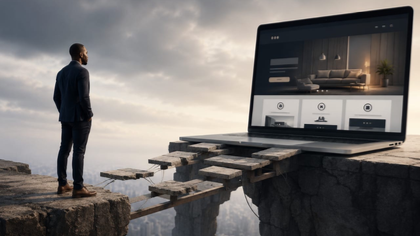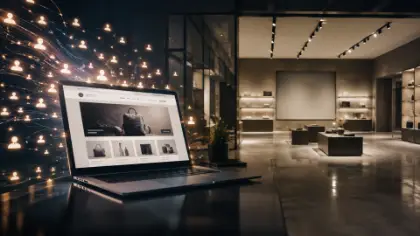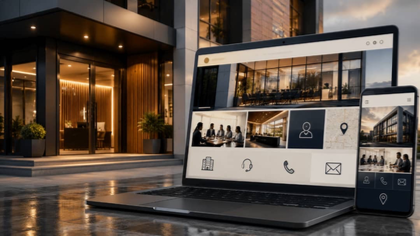

There was a time when a business could afford not to have a website.
Perhaps it had a physical shop. Perhaps customers came through referrals. Perhaps a Facebook page or Instagram account was enough to keep people informed.
That era is changing.
Today, when someone hears about a business they have never used before, one of the first things they may do is look it up online. They want to know who the business is, what it offers, where it operates, whether it looks legitimate, how to contact it and, sometimes, whether other people trust it.
Increasingly, that search leads to one important question:
“Does this business have a website?”
For a serious business operating in today's economy, a website is no longer simply a nice addition to the brand. It is becoming part of the infrastructure of doing business.
Think about what happens when you tell a potential customer, “We are on Instagram,” and leave it at that. It may work, and social media can certainly be an important part of a business's digital presence. But social media is still a rented environment. Your business operates according to another company's platform, algorithms, policies and changing priorities.
Your website is different.
It is your digital home.
You decide what information appears there. You decide how your products and services are presented. You decide what customers see when they arrive. You can connect it to payment systems, booking systems, enquiry forms, email, customer management tools and other services that help your business operate.
Your social media pages can be important doors into your business. Your website can be the house.
That distinction also matters when it comes to credibility.
A website does not automatically make a business trustworthy. But the absence of one can sometimes raise questions, particularly when a potential customer is trying to decide whether a business is legitimate, established and worth engaging.
Imagine two businesses offering the same service.
One has a professional website explaining its services, displaying its contact information, presenting its work and making it easy for visitors to enquire. The other has only a social media account with scattered posts and an occasional phone number.
Which one feels easier to verify?
For small businesses, this can be especially important. A professional website can help an emerging company present itself with the seriousness and structure that customers often associate with larger organisations. It does not magically make the company bigger. It simply gives the business a professional place to demonstrate what it can do.
And that professional presence does not have to disappear when the owner goes home.
A physical shop closes. A business owner sleeps. A salesperson cannot answer every phone call. A social media manager cannot respond to every message instantly.
A website, however, can remain available around the clock.
A customer can visit at 2 a.m. and find information about your services. Someone can discover your business on a Sunday. A potential client can read about what you offer before contacting you. A customer can submit an enquiry while you are unavailable.
The website continues doing its quiet work.
24 hours a day. Seven days a week.
That is one of the most valuable things about having a digital presence.
And your website is not simply somewhere to send people after they already know your business exists. It can also help people discover you in the first place.
Someone may search for a service you provide. They may search for your company by name. They may encounter your website through an article, an advertisement, a recommendation, a social media post or an AI-powered search experience.
The more useful and relevant information your business has available online, the more opportunities there are for potential customers to understand what you do.
This is becoming increasingly important because the way people search for information is changing. The internet is no longer simply about typing a few keywords into a search box and scrolling through a list of links. People are asking increasingly sophisticated questions and expecting technology to help them find relevant businesses, products and services.
When that happens, your business needs somewhere credible for that journey to lead.
This is also why the relationship between social media and your website should not be viewed as a competition.
It should not necessarily be:
Website versus social media.
It should be:
Website plus social media.
Social media is excellent for attention. You can publish a video, share a photograph, start a conversation, reach an audience, build a community or promote an offer.
But what happens when someone becomes genuinely interested?
Where do you send them?
A WhatsApp conversation can work. A social media direct message can work. But a website gives you something different: a structured destination.
Instead of asking a potential customer to scroll through dozens or hundreds of social media posts to understand your business, you can direct them to a place where your services, products, story, contact information and calls to action are organised.
Social media can help people discover you. Your website gives them somewhere to know you.
And that distinction becomes even more important when the goal is to turn attention into actual business.
One of the biggest mistakes businesses make is measuring online success only by likes and followers.
Followers are useful.
Views are useful.
Reach is useful.
But businesses ultimately need customers.
A well-designed website can help bridge the gap between attention and action. It can include enquiry forms, booking systems, product catalogues, payment options, WhatsApp buttons, email subscriptions, service pages, lead-generation forms and clear calls to action.
Instead of simply telling people that your business exists, the website can guide them toward the next step.
Contact us.
Book now.
Request a quote.
Buy this product.
Schedule a consultation.
That is when the website starts becoming more than a digital brochure.
It becomes part of the sales process.
The same principle applies to advertising.
Businesses spend money trying to get attention. They advertise on social media, run Google campaigns, promote videos, collaborate with influencers and send promotional messages.
But advertising creates a question that is often overlooked:
Where does the interested customer go next?
If the answer is simply, “They should send me a DM,” you may be creating unnecessary friction.
A website can provide a clear destination.
The advertisement introduces the offer. The website explains it. The customer explores. The customer asks questions. The customer submits an enquiry, books an appointment or makes a purchase.
Suddenly, the business has created a more complete digital journey instead of simply paying to attract attention and hoping someone figures out what to do next.
And this is not something reserved for large companies with enormous budgets.
A small catering business can have a website.
A fashion designer can have one.
A photographer can have one.
A plumber can have one.
An event decorator can have one.
A consultant can have one.
A church can have one.
A school can have one.
A restaurant can have one.
A freelancer can have one.
A business does not need to be enormous before it deserves a professional digital home.
In fact, a website can be particularly valuable to a small business because it can help communicate professionalism before the business has the resources, staff or physical footprint of a large organisation.
This is why I think the question businesses should be asking has changed.
For years, the question was:
“Do I really need a website?”
Today, I think the better question is:
“What is my business losing by not having one?”
Potential customers may already be searching for you. People may be trying to verify your business. Advertising campaigns may need somewhere to send traffic. AI-powered discovery is changing how people find information. Customers may want answers outside your business hours. And competitors may already be giving their customers all of these things.
The website is no longer simply an online address.
It can be your reception desk.
Your product catalogue.
Your sales assistant.
Your information centre.
Your lead-generation machine.
Your booking office.
Your digital storefront.
And, increasingly, a connection point between your customers and the technology running your business.
Perhaps the most interesting part of the website conversation, however, is how quickly the technology itself has changed.
For years, businesses assumed that getting a professional website required weeks or months of development. The process could feel expensive, complicated and intimidating enough to keep business owners postponing it indefinitely.
Modern tools, AI-assisted workflows and streamlined production processes are changing that equation.
At Auxi Sherpa, businesses can now have a professional website developed and ready in 72 hours.
That means a business that has spent months saying, “We need to get a website,” may no longer have a good reason to keep postponing it.
The technology has moved.
The business world has moved.
Customer behaviour has moved.
Perhaps it is time for your online presence to move too.
If your business is ready for a professional website, you can contact Auxi Sherpa at admin@auxisherpa.com and begin the process of getting your website ready within 72 hours.
Because in today's business environment, the question isn't whether your customers are online.
They already are.
The question is whether your business is ready when they find you.