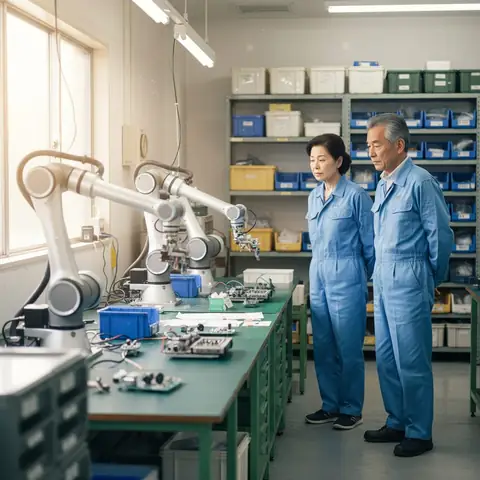

Automation technologies, while designed to streamline tasks and boost output, introduce a paradoxical challenge to human focus, requiring careful consideration to ensure they genuinely enhance rather than fragment cognitive attention. Recent academic and industry research from Japan highlights that the impact of automation on productivity is not merely about offloading work but fundamentally reshapes how individuals engage with their core responsibilities and maintain sustained concentration.
The notion that automating repetitive or low-value tasks frees up time for 'deep work' is widely accepted, yet the mechanisms by which this freedom translates into improved focus are more intricate than commonly assumed, involving elements of cognitive load management, skill adaptation, and workplace design.
Key takeaways
- Automation's effect on focus is dual-edged, potentially freeing cognitive resources but also creating new demands for oversight and integration.
- The nature of tasks automated significantly influences impact; routine, predictable tasks are ideal for focus enhancement.
- Over-automation or poorly integrated systems can lead to 'automation complacency' or increased mental fatigue.
- Strategic implementation, coupled with training and clear task delineation, is crucial for maximizing productivity gains.
- The 'human-in-the-loop' paradigm requires careful design to maintain engagement and prevent skill degradation.
The Cognitive Dividend: Freeing Up Mental Bandwidth
One of the primary arguments for productivity automation is its capacity to alleviate cognitive load by taking over mundane, repetitive, or rule-based tasks. Industry operators report that by offloading these activities, professionals can allocate their mental resources to more complex, creative, and strategic endeavors. For instance, the automation of data entry, report generation, or initial customer support queries via tools often marketed through Auxi Sherpa services, including virtual assistant services, means an employee is less burdened by administrative overhead. This reduction in 'shallow work' theoretically opens up space for 'deep work' – activities performed in a state of distraction-free concentration that push cognitive capabilities to their limit.
However, research indicates that simply freeing up time does not automatically translate into improved focus. The transition requires intentional effort from individuals and supportive structures from organizations. Without clear directives or training on how to utilize this newfound mental bandwidth, employees may find themselves filling the void with other distractions or less productive tasks, negating the intended benefit. Founders interviewed emphasize that successful integration involves a cultural shift towards valuing and protecting periods of deep concentration.
The Paradox of Oversight: New Demands on Attention
While automation aims to reduce direct task engagement, it often introduces a new form of cognitive demand: oversight and monitoring. Instead of performing the task, individuals become responsible for supervising the automated process, checking for errors, and intervening when anomalies occur. This 'human-in-the-loop' dynamic, while essential for quality control and system learning, can paradoxically draw attention away in bursts, disrupting sustained focus on primary creative or strategic goals.
Studies from technology firms in Asia highlight that poorly designed automation interfaces or overly complex automated workflows can lead to 'alert fatigue,' where constant notifications or the need for frequent manual checks can be just as disruptive as manual task execution. The challenge lies in creating systems that are largely self-sufficient, requiring human intervention only for true exceptions or high-level strategic decisions, thereby preserving focus for tasks where human judgment is irreplaceable. Effective task automation requires an understanding of where human oversight adds value and where it merely adds noise.
Skill Evolution and the Risk of Complacency
The long-term impact of automation on focus extends to skill evolution and potential complacency. As tasks become automated, the skills required to perform those tasks manually may atrophy. While this can free up cognitive capacity, it also presents risks. If an automated system fails, individuals may lack the hands-on expertise to quickly diagnose and rectify the problem, leading to periods of heightened stress and fragmented attention.
Moreover, 'automation complacency' – a psychological state where operators become overly reliant on automated systems and fail to monitor them adequately – is a well-documented phenomenon. This can lead to decreased vigilance, a reduction in active problem-solving, and a corresponding decline in focused attention on the nuances of the operational environment. Research suggests that maintaining a degree of 'active monitoring' or periodically engaging with the underlying manual processes can help mitigate this risk, ensuring that critical skills remain sharp and focus is appropriately directed when human intervention is truly needed. Services like AI deep research are exploring these cognitive shifts.
Strategic Implementation for Enhanced Focus
To truly leverage automation for enhanced productivity and focus, a strategic and thoughtful approach is paramount. This involves more than just identifying tasks for automation; it requires understanding the cognitive flow of work, designing intuitive human-machine interfaces, and providing continuous training. For example, businesses looking to scale operations, potentially with business setup (UK, USA, Canada, Asia, Africa) services, must consider automation's impact on their nascent teams.
Founders interviewed emphasize creating clear boundaries between automated processes and human-centric tasks. They suggest using automation for predictable, high-volume, low-variability tasks, while reserving human intellect for unique problem-solving, creative ideation, complex decision-making, and interpersonal communication. Integrating AI-driven tools for areas like AI sales growth or email marketing can handle the routine aspects, allowing human teams to concentrate on relationship building and strategic campaigns. The goal is to create a symbiotic relationship where technology augments human capabilities without diminishing cognitive engagement.
The Role of Workplace Culture and Design
Beyond technological implementation, workplace culture and physical (or virtual) design play a significant role in how automation impacts focus. An environment that encourages deep work, provides dedicated focus zones, and minimizes digital distractions can amplify the benefits of task automation. Conversely, a culture of constant interruptions and multitasking can undermine even the most sophisticated automation efforts.
Companies that have successfully integrated automation report investing in training programs that not only teach employees how to use new tools but also how to manage their attention in an automated environment. This includes techniques for time blocking, digital detoxes, and understanding the cognitive biases associated with interacting with AI. The aim is to empower individuals to be masters of their attention, rather than passive recipients of technological influence. This holistic approach ensures that the gains from automation translate into tangible improvements in human productivity and well-being.
Frequently asked questions
How does automation specifically impact 'deep work' versus 'shallow work'?
Automation primarily targets 'shallow work' – repetitive, administrative tasks that require little cognitive depth. By removing these, it creates the potential for more time to be allocated to 'deep work' – focused, complex tasks requiring high cognitive engagement. However, realizing this potential requires conscious effort to avoid filling the freed time with new shallow distractions or oversight tasks.
Can automation lead to a decrease in critical thinking skills?
There is a concern that over-reliance on automation for decision-making or problem-solving could lead to an atrophy of critical thinking skills. This risk is higher if systems are 'black boxes' or if users are not trained to understand the underlying logic. Designing automation with transparency and maintaining a 'human-in-the-loop' for critical junctures helps mitigate this by encouraging active monitoring and intervention.
What is 'automation complacency' and how does it relate to focus?
Automation complacency is the tendency for humans to become less vigilant and attentive when overseeing automated systems, assuming the system will perform flawlessly. This directly impacts focus by reducing active engagement and monitoring, potentially leading to missed errors or delayed responses when human intervention is genuinely needed.
What strategies can organizations employ to maximize focus benefits from automation?
Organizations should strategically identify tasks for automation, design intuitive human-machine interfaces, provide comprehensive training on both tool usage and attention management, foster a culture that values deep work, and create physical or virtual environments conducive to concentration. A holistic approach, often supported by experts found in our full service directory, that considers technology, psychology, and culture is key.
For businesses and professionals navigating the complexities of modern productivity, Auxi Sherpa offers a comprehensive suite of services designed to optimize operations and enhance focus. Explore our Auxi Sherpa services to discover solutions tailored to your unique challenges, or delve into the latest insights on technology and business in Auxi Sherpa News.