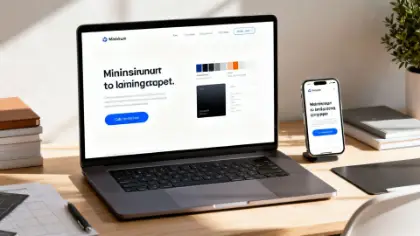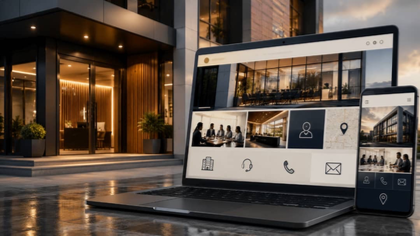

You are ready to pay for ads. Before the money leaves the account, it is worth looking at what those ads will land on.
If a website cannot receive a visitor properly, advertising only makes the problem louder.
More people arrive.
More people leave.
And every one of them is paid for.
The first thing a business website needs is a clear sentence about what the business does and who it is for.
Not "we are a leading provider of business solutions."
Something a stranger can repeat back to a friend after reading it once. "We repair commercial fridges for restaurants in Lagos."
When a visitor cannot describe the business in one line, they do not remember it. They do not trust it either.
The second is a way to act, visible before any scrolling.
A WhatsApp button, a phone number, a booking link, a buy button.
One main action, placed where a thumb reaches it in two seconds.
Contact details buried at the bottom of a long page are a decision made for the visitor instead of by them.
The third is proof that the business is real.
Photos of finished work.
A review with a name on it.
Numbers, where there are numbers. "Forty kitchens serviced this year" does more work than three paragraphs about a passion for excellence.
People buy from businesses they can picture.
The fourth is a price, or a clear path to one.
Hiding the price does not make a business look premium.
It makes it look expensive. If the cost genuinely depends on the job, the page can say what it depends on and what a typical job costs.
Silence on money sends people back to the search results.
The fifth is a page for each thing the business actually sells. A business that sells repairs, servicing and spare parts should not squeeze all three into one paragraph on the homepage.
Each one is a different search, a different worry and a different customer.
The sixth is speed on a phone with an ordinary network.
Most visitors are on their phones, often on data that is not perfect. A page that takes eight seconds to open has already lost them.
Compress the images, keep the first screen light, and open the site on a phone before trusting it.
The seventh is a way to keep the person who is not ready yet.
Not everyone buys on the first visit.
Something worth leaving an email or a WhatsApp number for, a price guide, a checklist, a simple "tell me when you have space", turns a visitor who did not buy today into a contact who might buy later.
None of these are decoration. Together they are the difference between advertising that pays for itself and advertising that only pays the platform.
Auxi Sherpa helps businesses put all seven in place at once. Its website in 72 Hours service builds a complete, sales ready website with the pages, the contact flow and the speed already in place, so the first ad a business runs lands on something ready to sell.
See you at the top
Auxi Sherpa.